Thursday, May 30, 2013

Taking printout of the whole internet?

Kenneth Goldsmith wants to print out the entire Internet, and he needs your help.

Kenneth Goldsmith wants to print out the Internet. And he wantsyou to help him attempt this presumably impossible feat. 

“What you decide to print out is up to you — as long as it exists somewhere online, it’s in,” Goldsmith’s announcement explains. “We just want shitloads of paper. We’re literally looking for folks to print out the entire internet. We have over 500 square meters of space to fill, with ceilings that are over 6 meters high.” This exhibition (if that’s the right word for it) will go on view July 26; when it ends in August, the paper will be recycled.

The project was inspired by, and is dedicated to, Aaron Swartz, the programmer-activist who committed suicide earlier this year, and who had been accused by federal prosecutors of breaking various laws in the course of downloading a giant cache of academic articles from the JSTOR service. Like Swartz, Goldsmith is a believer in information availability.

“The amount of what he liberated was enormous -- we can't begin to understand the magnitude of his action until we begin to materialize and actualize it,” Goldsmith said when reached via email. “This project tries to bring that point home.”

If you’re familiar with Goldsmith, the idea to print out the entire Internet may not be a surprise: Currently serving as the Museum of Modern Art’s first poet laureate, and the founding editor ofUbuWeb, a sprawling online archive of avant garde creativity, Goldsmith is an unusual thinker, to say the least. His books includeDay (which involved retyping an edition of The New York Times);Solilquy (which documentedevery word that he spoke for an entire week); the recent Seven American Deaths and Disasters(transcripts of media reports from 9/11, the day John F. Kennedy was shot, and so on); and Uncreative Writing (which makes the case for repurposing existing texts into new forms of literature).

Still, even by Goldsmith’s standards, this scheme sounds like a doozy. In cooperation with UbuWeb and Labor, a gallery in Mexico City, Goldsmith has issued an open call to everyone everywhere to “print out as much as of the web as you want — be it one sheet or a truckload,” and send the printouts to the gallery.

Not surprisingly, some have reacted to this with eye-rolling, or outrage. “Might be the worst idea for an art project I’ve seen recently.” “ What a pointless waste of paper and money. Is it art for art's sake or just crap?” “ Neat conceptual art piece, the actual realization of which is an unbelievably stupid idea.” And so on.Goldsmith, however, was unfazed by the criticism.

“While we could theorize printing out the internet in its entirety -- something that a conceptual art piece would do -- the sheer bulk and physicality of the act needs to be materialized to be able to understand the sheer magnitude,” he told me via email.

Sure the task seems impossible, he conceded, but even a small portion of the printed Web would “overwhelm any space.”

And that’s what the project is getting at. Interestingly, it also happens to tie directly to Goldsmith’s past work: “quantifying ephemeral material.” In this instance, the goal is to “literally materialize the amount of information around us.” In the Internet era, figuring out what to do with information that exists is more meaningful than generating more information: “The advent of digital culture has turned each one of us into an unwitting archivist,” hoarding endless MP3s and digital pictures and old emails, he continued.

“I think it's fair to say that most of us spend more time organizing and managing our cultural artifacts that we do actually interacting with them. This is a new condition, something that the concept of this show wishes to underscore.”

Amusingly, this gesture toward grappling with endless digital documentation will in fact be documented at printingtheinternet.tumblr.com — where anyone who donates printed Web material will be listed as a contributing artist. But Goldsmith has hopes for the physical hoard avoiding death by recycling in August: “I’d love to see it grow and travel, moving to Biennials, getting larger and larger,” he mused.

And c’mon, aren’t you at least a little bit tempted to be a part of such an unlikely effort? Feel free to print out your favorite Yahoo Tech story and send it to Mexico. The address for all submissions is below.

LABOR
Francisco Ramírez #5
Col. Daniel Garza
Del. Miguel Hidalgo 11830
México D.F.

-YahooNews

Electronic tattoos and password pills: Motorola working on the future

We’ve seen people talk about the upcoming Google Glass and the ever-elusive iWatch. Apple CEO Tim Cook even went on to say that the wrist is where the future lies. Motorola begs to differ. Say hello to electronic tattoos and passwords you can swallow.

Speaking at the D11 Conference by All Things Digital, Regina Dugan, SVP for advanced technology and projects for Motorola showed off what exactly the now Google-owned company thinks the future of wearable computers is. She showed off a prototype electronic tattoo on her own arm at the conference. “Teenagers might not want to wear a watch, but you can be sure they'll wear a tattoo just to piss of their parents,” she said.


If you’re already thinking about an electronic tattoo and going “Whoa, dude!” wait till you read what it can do. A normal tattoo would probably be an identification mark to most people. If you have a tattoo, chances are, your friends and family will be able to identify you based on that skin art alone. The electronic tattoo showed off by Dugan can authenticate a user, replacing the need for passwords. 

The skin patch is being made by a company called MC10 that Motorola is partnering with.

Besides the tattoo, Motorola is working on another prototype, a slightly more serious option than a skin patch – Vitamin authentication. Here’s a pill that can eliminate the need of passwords. Dugan showed off a pill that can be ingested. The pill developed by Proteus Digital Health is powered by the acid in your stomach. Once inside your body it creates 18-bit signals turning your entire body into a password. Creepy, huh? 

Don’t wait on this technology to be available to you soon, though. “This isn’t stuff that is going to ship anytime soon. But it is a sign of the new boldness inside Motorola,” explained Dennis Woodside, head of Motorola. The bottomline is that this technology is that it is all going to be optional. Google won’t be force feeding you these pills like this is some kind of a twisted, science-fiction movie.

-Tech2in

Facebook now verifying pages and profiles

Taking a leaf out of Twitter’s book, Facebook has started to roll out verified status to high-profile accounts of people and businesses to lend them authenticity. Verified pages will now sport a white check mark on a blue background, quite similar to what Twitter does for its verified accounts currently. 

These verified pages will extend to prominent public figures like celebrities, journalists, government officials, popular brands and businesses that have a large number of fans. The blue check mark will show up for verified accounts in search results as well as elsewhere on Facebook.


The social networking giant will also be rolling this update out to profiles shortly. Prominent public figures that use a normal profile and have a large number of subscribers will also stand a chance to get the verified status from Facebook. 

In a Help Centre page, Facebook mentions that it is verifying pages to help users be sure that the page they’re liking belongs to the person the owner claims to be. It also attaches a word of caution to this exercise, “Keep in mind that not all authentic profiles and Pages are verified and that you can't request to have your profile or Page verified.” 

Facebook has not made the process it uses to verify accounts public right now. Twitter, the social networking website that originally introduced the concept of verified accounts, too does not reveal how it goes about verifying accounts. Pages of celebrities and performers like Selena Gomez, Metallica, Amitabh Bachchan and more have already received that blue check mark beside their names on their pages. Facebook founder Mark Zuckerberg and sister Randi Zuckerberg’s profiles now sport check marks as well. 

The move, though a little later than expected, is going to help Facebook separate fan pages from official accounts, making it simpler for users to know who they’re following. It’ll help Facebook fans keep up-to-date with information about public figures they care about. The social networking giant seems to be bridging the gap between fans and public figures now. If you thought you could only feel close to your favourite celebrities by following them on Twitter, think again. Facebook Pages are bound to give Twitter some tough competition.

-Tech2in

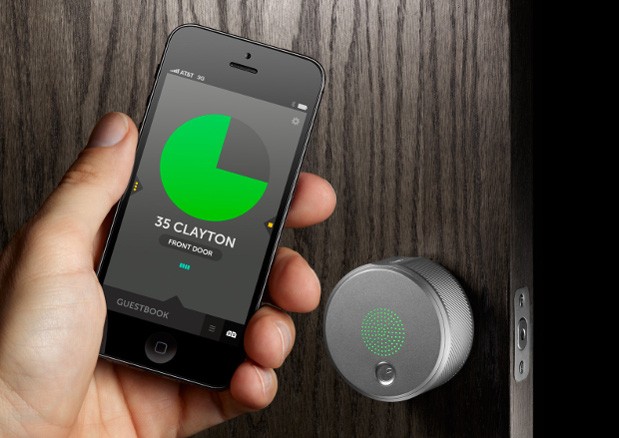
August: the beautiful, Yves Behar-designed $199 smart lock

The home automation market is really starting to take off, and surprisingly, it's door locks that are proving to be one of the biggest areas of interest. Established home security companies like Kwikset and mobile carriers (via unnamed OEMs) are working to combine smartphones and deadbolts, while startups like Smart Knob are using offline technology to simplify vacation rentals. August, the brainchild of Yves Behar and Jason Johnson, combines elements of both approaches and does so with Behar's typical flair for stunning design. The primary way of unlocking an August-equipped door is through an app that pairs with the stylish mechanism via Bluetooth. But it skips out on the direct internet connection, which could leave it more vulnerable to hacks.

Instead, it passes all necessary online communications through the paired phone or tablet. In fact, it's capable of operating without an internet connection at all, since it relies on algorithmically generated keys, similar to a secure ID token. Those "keys" are assigned to specific devices, that also have the app installed, which are identified via Bluetooth LE. Each lock is synced up with Augusts' servers and attached to a unique account that you manage through the companion app. And, even if the batteries die, you can still use the old standby: an actual key.

-Engadget

Eye mouse for the physically challenged

MANGALORE: Four final-year electronics and communication engineering students have developed an " Eye Mouse", an input device for people who are unable to move their hands.

Shruthi Shettigar, Prasad Nayak, Vanishri and Sandhya Shet of the Srinivas Institute of Technology (SIT) developed the device under the guidance of associate professor Sathish Kumar K and Bheema Shastry, head of the department of electronics and communication engineering, SIT.


Sathish told TOI the students developed an application and installed it on a webcam-connected computer. The computer is connected to a light-dependent resistor circuit that is fixed to a chair. Once a physically challenged person sits on the chair, the computer turns on and the webcam captures the person's eyeball movements, says Sathish. The recorded video is automatically uploaded to the application developed by the students.

"After this, a physically challenged person can start using the computer without using a mouse," says Sathish. "The user has to just stare closely at the folder or icon, and within few seconds the folder opens."

Through eyeball movements, the cursor can be moved on to any folder.

The students, who spent Rs 5,000 on the innovation, are trying to get a patent for it. "After getting a patent, we will launch this product in the market to help the handicapped," says Sathish.

-TOI

Teen's Invention Could Create 20-Second Phone Charge


Tech manufacturers that boast how fast their devices can juice up might want to listen up: A California teen has developed a super-capacitor that could lead to a 20- to 30-second phone charge.

Super-capacitors are energy-storage devices that have a long cycle life, and have the potential to store a lot of energy per unit volume. Sounds dandy, right? Not quite. The devices have limited use because they store less energy than batteries. But Eesha Khare, 18, of Saratoga, Calif. has made quite an advancement with this technology.

"The super-capacitor I have developed uses a special nanostructure, which allows for a lot greater energy per unit volume," Khare said in a video interview at last week's 2013 Intel International Science and Engineering Fair in Phoenix. The world's largest science fair brought together 1,600 high-school finalists from all over the world, who competed for more than $4 million in awards.

"It can charge very quickly, and it can last for 10,000 cycles, compared to batteries which are only like 1,000 cycles," added Khare, a student at Lynbrook High School in San Jose, Calif.
Imagine this: If this sort of technology replaces conventional batteries, our gadgets could someday spend much less time plugged in, as demonstrated by Khare's test with an LED light.

"After charging my super-capacitor for 20 seconds, I was able to light an LED device," she said. "Just seeing that LED light was my signal that I know what I'm doing, and this is truly applicable to the real world."

A phone could be fully charged in 20 to 30 seconds since Khare's tiny device fits inside cell-phone batteries. This sort of advancement in energy storage could also be applied to laptops and electric vehicles, among other devices.

As part of Intel's competition, Khare won a $50,000 Intel Foundation Young Scientist Award (pictured above, far left). After receiving the award, Khare said she wants to "just keep making a lot of scientific advancements."

Khare, who reportedly has already generated interest from Google, will be attending Harvard University this fall, according to San Francisco CBS affiliate KPIX.

Other high-school participants in last week's Intel fair that Mashable has featured include Brittany Wenger, who developed a computer algorithm to diagnose leukemia, and Justin Krell, who invented a concussion-detection prototype for car accidents.

-Mashable, Intel

Twitter adds two-step authentication to boost security after hacks

Twitter has become the latest site to add two-step verification to its security system following a number of hackings and attempted hacks.

The optional verification procedure, already available for services such as Google's Gmail and Facebook, follows the usual format of registering a phone number to be used in conjunction with your existing login details.

With the system turned on (select "require a verification code when I sign in" from the account settings) Twitter will send a six-digit code to your phone as an SMS whenever you sign in to twitter.com.

For access from apps and other devices you need to generate a temporary password, done by visiting the applications page, in order the authorise the login.

As the process hinges on Twitter being able to send SMS to your phone, using the security system will depend on whether your phone service provider supports the functionality. We tested ours using GiffGaff -- a phone service provider which utilises the O2 network -- and it worked correctly.

Despite the added protection two-step can provide, Twitter is keen to point out you'll still need to follow good security practice:

"Of course, even with this new security option turned on, it's still important for you to use a strong password and follow the rest of our advice for keeping your account secure."

Said advice can be found on the "Keeping your account secure" page.

-Wired